Recipe: compare two electricity offers for your usage
Two energy suppliers sent you offers with different prices per day, per kWh and per time of day. Give both PDFs to Hermes, tell it how much electricity you use and when, and get the monthly cost of each offer with the maths, the point where they cost the same, and anything in the offers that does not add up.
| Time needed | 5 minutes |
| You need | A Hermes agent connected to an AI model, the two offers (PDF) and your usage from a recent bill (kWh per month, and how much at night if you know it) |
| Result | The monthly and yearly cost of each offer, the break-even point and a list of things to watch |
1. Upload the two offers
In the dashboard, open FILES, go into the workspace folder and click UPLOAD (see Hermes reads a contract for you). Upload both PDFs.
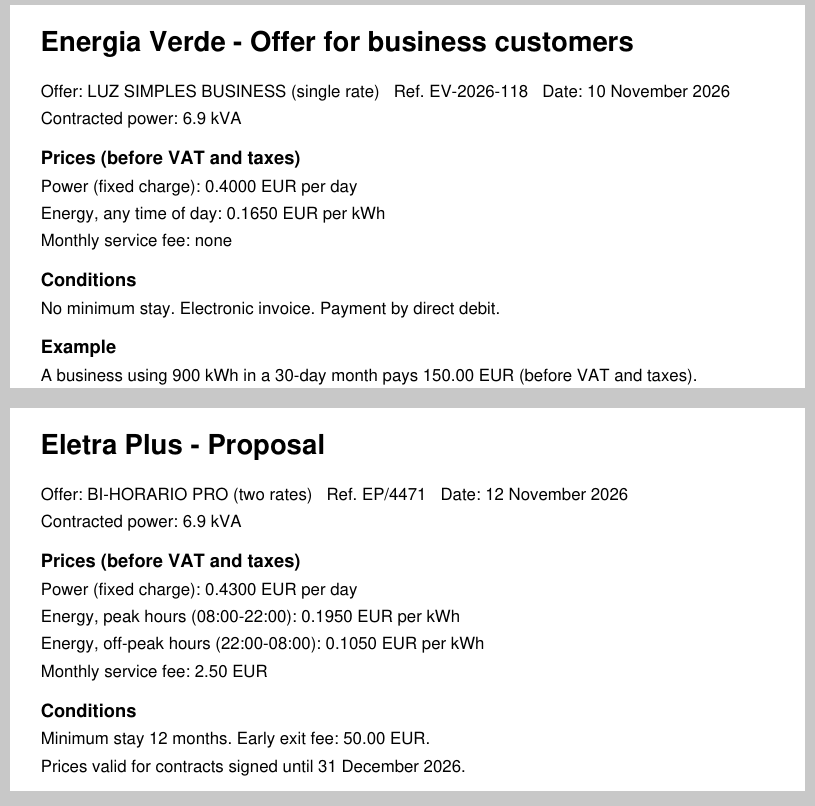
For our test we made two short offers from two made-up suppliers for a bakery. Offer A has one price at any time of day. Offer B is cheaper at night, more expensive by day, and adds a monthly fee and a minimum stay. We also put a mistake in offer A on purpose: its Example line says 900 kWh cost 150.00 EUR a month, but with its own prices it is 160.50 EUR.
2. Give your usage and ask for the comparison
Find on a recent bill how many kWh you use in a month and, if your meter splits it, how much is at night (off-peak). In CHAT we wrote:
Open workspace/offer-a.pdf and workspace/offer-b.pdf: two electricity offers for my bakery. We use 900 kWh a month (30-day month) and 45% of it is off-peak (22:00-08:00), because the ovens start at night. Work out the monthly and yearly cost of each offer before VAT and taxes, show the maths and tell me which is cheaper. At what off-peak share do both cost the same? Also tell me if anything in the offers does not add up. Answer in English.
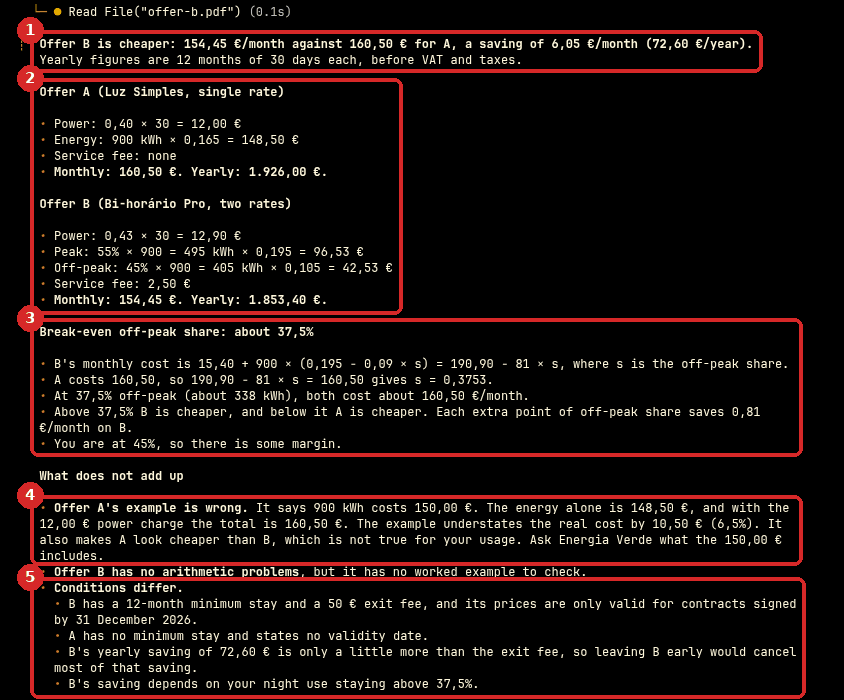
- The answer first: offer B is cheaper, 154.45 EUR a month against 160.50 EUR, a saving of 6.05 EUR a month (72.60 EUR a year).
- The maths for each offer: daily power charge × 30 days, energy (for B split into day and night kWh), and the monthly fee.
- The break-even point: below about 37.5% of night use, offer A is cheaper. We are at 45%, so there is some margin.
- Hermes found our mistake: offer A's example (150.00 EUR) leaves out the 12.00 EUR power charge and makes A look cheaper than it is. It suggests asking the supplier.
- What the price does not show: B has a 12-month minimum stay with a 50 EUR exit fee, and its prices are only valid for contracts signed until 31 December 2026. Hermes notes that the yearly saving is only a little more than the exit fee.
Hermes wrote the amounts with a decimal comma (154,45 €), as is usual in Portugal.
Check that it worked
We calculated everything ourselves before asking Hermes. All the numbers were correct:
| Offer A | Offer B | |
|---|---|---|
| Power: 30 days × daily charge | 30 × 0.40 = 12.00 | 30 × 0.43 = 12.90 |
| Energy by day | 900 × 0.165 = 148.50 | 495 × 0.195 = 96.525 |
| Energy at night | (same price) | 405 × 0.105 = 42.525 |
| Monthly fee | 0.00 | 2.50 |
| Per month | 160.50 EUR | 154.45 EUR |
| Per year | 1,926.00 EUR | 1,853.40 EUR |
The break-even night share is 37.53%, and the 150.00 EUR example in offer A is wrong. Hermes caught both.
All amounts are before VAT and taxes, because that is how the offers gave their prices. A real bill adds VAT and other taxes and charges, so it will be higher. Compare offers on the same basis.
Make it yours
- Your own usage: copy the kWh from your last 12 bills and ask "Use the real kWh of each month."
- Phone and internet offers: give your minutes, data and lines, and the length of each contract.
- More than two offers: "Put them in a table from cheapest to most expensive for my usage."
- A reply: "Write a short email to supplier A asking about the 150 EUR example."
Common problems
Hermes trusted the supplier's own example
Ask, as we did, "tell me if anything in the offers does not add up". In our test Hermes then worked out the cost from the prices and compared it with the example in the offer.
I do not know how much I use at night
Your bill or the meter may show it as vazio (off-peak) and fora de vazio (peak). If not, ask for the break-even point, as we did: if your night share is far from it, the answer will not change.
Prices with or without VAT?
Say it in the message ("before VAT and taxes"). If one offer includes VAT and the other does not, tell Hermes to compare both without VAT.